How to Choose Water Heater Size Right
Nobody wants to be halfway through a shower when the hot water quits. That is usually the moment homeowners start asking how to choose water heater size, and the answer is not just picking the biggest tank you can afford. Too small, and you run out of hot water. Too large, and you pay more upfront and more to keep water hot that you may not even use.
For homes around Decatur and Metro Atlanta, the right size depends on a few real-life factors: how many people live in the house, when hot water gets used, what kind of heater you want, and whether your current plumbing and fuel setup support it. A family of four that showers one at a time has very different needs than a family of four doing laundry, dishes, and back-to-back showers before school and work.
How to choose water heater size without guessing
The simplest way to think about sizing is this: you are not buying hot water for the whole day, you are buying enough hot water for your busiest hour. Plumbers call that peak demand. It matters more than total daily use because your water heater has to keep up when everyone seems to need hot water at once.
If you are choosing a traditional tank water heater, the main number to watch is first-hour rating. That tells you how many gallons of hot water the unit can deliver in the first hour when starting with a full tank. If you are choosing a tankless unit, you look at flow rate, measured in gallons per minute. That tells you how much hot water it can produce continuously.
Those are two different ways to size a heater, which is why shopping by gallons alone can lead people in the wrong direction.
Start with your household's hot water habits
A rough headcount helps, but habits matter just as much. Two adults in a home may do fine with a smaller setup if they stagger showers and run the dishwasher at night. On the other hand, a three-person household can need a larger system if everyone gets ready at the same time every morning.
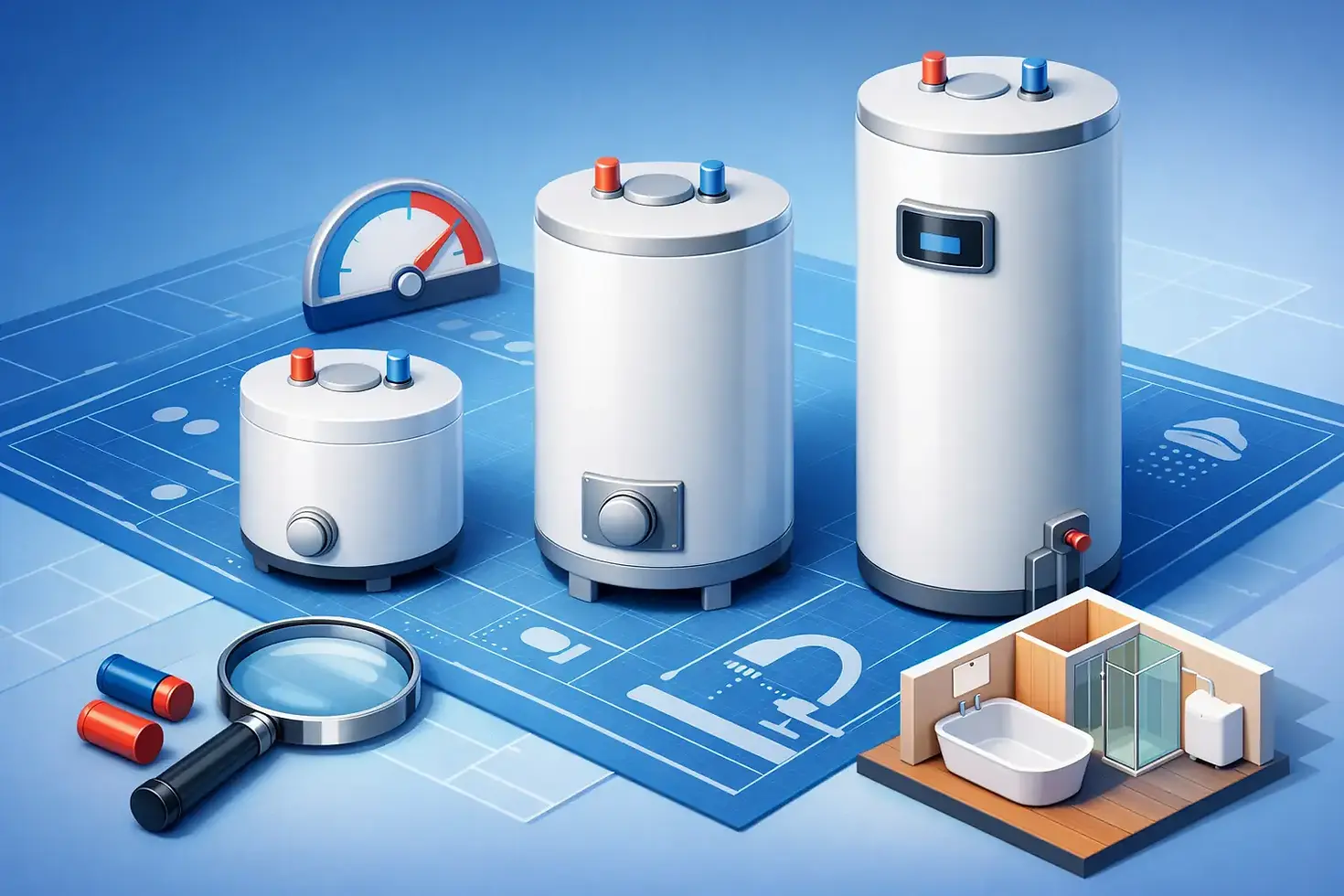
Here is a practical rule of thumb for tank water heaters. A one- to two-person household often does well with a 30- to 40-gallon unit. A two- to three-person household usually lands around 40 to 50 gallons. A three- to four-person household often needs 50 to 60 gallons. A larger family may need 60 to 80 gallons, depending on usage.
That said, these are starting points, not guarantees. If your home has a large soaking tub, multiple full bathrooms, a high-demand showerhead setup, or a teenager who thinks a shower is a part-time job, you may need to size up.
Think about the busiest hour, not the whole day
Most homes do not use hot water evenly. The real test is what happens during the morning rush or right after dinner. If one person showers, another starts the dishwasher, and a load of laundry is running, your heater has to handle all of that in close succession.
A typical shower may use around 10 to 15 gallons of hot water. Dishwashers and washing machines vary, but each can add a meaningful load depending on the model and settings. If your busiest hour includes two showers plus appliance use, a small tank may not recover fast enough.
This is one of the biggest mistakes homeowners make. They replace an old tank with the same gallon size without asking whether the old one ever really kept up.
Choosing tank size by first-hour rating
If you are installing a storage tank water heater, first-hour rating is more useful than tank capacity by itself. A 50-gallon heater with strong recovery can outperform another 50-gallon model with a lower first-hour rating. Recovery rate depends on the burner or heating element, incoming water temperature, and the unit's design.
In the Atlanta area, incoming groundwater temperature is generally milder than in colder parts of the country, which can help water heaters perform a little better. But that does not mean every unit is right for every home. If your family has high demand, mild weather alone will not make a small heater feel bigger.
As a general guide, if your peak-hour demand is around 40 gallons, choose a unit with a first-hour rating that meets or exceeds that number. If your demand is closer to 60 gallons, your heater should be rated accordingly. This is where a professional opinion can save you from buying based on price tag alone.
How tankless sizing works
Tankless water heaters are sized differently, and that is where confusion usually starts. With tankless, you are not storing gallons. You are heating water as it flows through the unit. So the key question becomes how many fixtures may run at the same time.
A shower might use 2 gallons per minute. A bathroom faucet might use 1 gallon per minute. A dishwasher or washing machine may use 1 to 2 gallons per minute depending on the appliance. If your home may run two showers and a sink at once, you could need 5 gallons per minute or more.
Then there is temperature rise. The heater has to warm incoming water to the temperature you want at the tap. The bigger the temperature rise, the harder the unit has to work, and the lower the effective flow rate can be. That is why a tankless unit that looks fine on paper may still disappoint if it is undersized.
Bigger is not always better with tankless either
Homeowners sometimes assume tankless means unlimited hot water no matter what. That is only true within the unit's flow limits. If demand exceeds capacity, water temperature can drop. So yes, tankless can be a great fit, especially for homes that want efficiency and longer run times, but it has to be matched to the house.
In some homes, a whole-house tankless unit makes sense. In others, a properly sized tank water heater is the better and more cost-effective answer. It depends on usage, budget, and the home's gas or electrical capacity.
Fuel type changes the sizing conversation
Gas and electric water heaters do not always perform the same way, even at the same tank size. Gas units typically recover faster than standard electric tank models. That means a gas 50-gallon unit may keep up better during heavy use than an electric 50-gallon model.
If you are replacing gas with gas, or electric with electric, the sizing decision may be fairly straightforward. If you are switching fuel type or considering tankless, the job gets more involved. Gas line sizing, venting, electrical requirements, and space all matter. This is one reason honest plumbing advice matters so much here. You want the setup that fits your home, not a sales pitch for the most expensive option.
Signs your current water heater is the wrong size
If you are not sure whether your current unit is too small, the house usually tells you. The obvious sign is running out of hot water during normal use. Another clue is having to space out showers and chores just to avoid cold water.
An oversized heater can be harder to notice, but it shows up in higher operating costs and paying for more equipment than you need. If your current tank is large and your household has shrunk over time, there may be room to downsize when replacement day comes.
Older homes can add another layer. Plumbing layout, long pipe runs, and fixture upgrades can make a heater seem undersized even when the tank itself is technically adequate. Sometimes the issue is not only the heater. It is the full system.
When to call a plumber instead of relying on a chart
Charts are helpful, but they cannot see your house. They do not know if you have three bathrooms, a garden tub, teenagers, an aging unit with slow recovery, or an addition that changed your usage. They also do not tell you whether your venting, gas line, drain pan, expansion tank, or shutoff setup should be updated during installation.
That is where a local plumber can give you practical guidance without making it complicated. A good recommendation should be based on your home and your habits, not a one-size-fits-all script. Around here, homeowners usually appreciate straight answers and fair options, and honestly, that is how it should be.
If you are comparing replacement choices, it can help to describe your busiest hour in plain terms. Say how many people live in the home, how many bathrooms you have, whether showers happen back to back, and whether appliances tend to run at the same time. That information often tells more than the old tank's label.
Choosing the right water heater size is really about avoiding daily frustration and unnecessary cost. You want enough hot water for real life, with a system that fits your home and budget. If you are not sure what size makes sense, getting a straightforward opinion from a local master-plumber-led team like TPD can save you from paying for the wrong solution twice.
The best water heater is not the biggest one on the shelf. It is the one that keeps up with your household without wasting your money.


Comments